
The WLLID 2025 AGM will be held on 29 October 2026 at 7pm, Wasa Community Hall.
A review of 2025 activities will be presented along with a water report and the financial statements.
Following the AGM, a vote to elect four (4) Trustee positions will be held.
Six residents have accepted nominations: Pam Schneider, Sharon Prinz, Marli Price, Pam Heaton, Penny Flagel and Kathryn Fitzgerald.
Residents welcome to attend.
The WLLID monitors water levels and tracks data going back to the early 1990s. Using that data and historical snow pack levels at Floe Lake, statistical analysis shows that a significant portion of the water level increase comes from the Flow Lake snow pack.
Based on analysis of this years data-Wasa water level and Floe Lake snow pack-WLLID estimates the peak water level this year will be 769.20 masl, plus or minus 10%. This means the peak water will fall between 768.74 on the low side and 769.65 on the high side.
For lake front residents who have experienced flooding in the past, WLLID suggests taking some early precautions to protect buildings and property.
There have only been three previous years when the water level peaked above 769.00. They were 2022, 2020 and 2017.
The average peak water level since 2014 is 768.63 masl.
As of June 3, 2026, the water level at Wasa was 768.48 masl which is 1.20m (3 feet 11 inches) higher than on the same day last year.
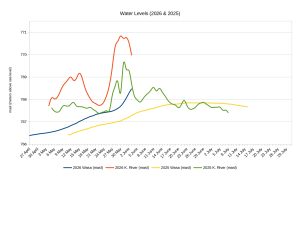
Over the past 7 days the water has risen 1.0 meters or three feet three inches.
Currently, the water is already 64cm (2 feet 1 inch) higher than the peak level last year.
The volume of water added since freshet started is equal to 2.78 million cubic meters, or 2.78 billion liters which is the same as 1,111 Olympic-size swimming pools.
Water updates will be posted on the WLLID website every few days as we approach peak water.