Larratt Aquatic will present its research findings into water and sediment quality on 17th June, 2026, at the Community Hall starting at 7pm.

The event will be live streamed for those who are not able to attend in person.

Copy this link and paste into a browser to access the presentation – https://teams.microsoft.com/l/meetup-join/19%3ameeting_YjQ3YTlmYTYtNDg4ZS00OGJjLTllMGQtOTc4NGZkZWEwYzA4%40thread.v2/0?context=%7b%22Tid%22%3a%2240de877f-18d0-464c-949e-101040223714%22%2c%22Oid%22%3a%22d095a3ad-1e7a-4ac1-b86b-b4ba1a48fedd%22%7d

A recording of the presentation will also be available.

Read the Larratt report. Go to the Resources tab, click on the Reports section then scroll down to the report.

Next WLLID Board meeting, 8th July at 7pm, Community Hall, lower level. Residents welcome to attend.


Wasa Lake Land Development District Logo

Water Quantity

Residents who see or are experiencing flooding, are asked to call the RDEK 24-hour emergency line 250-489-9677.

Updates

8 June Water Update

June 8, 2026

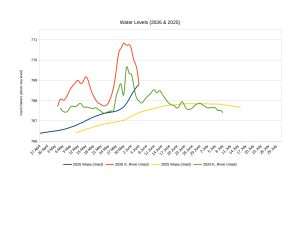
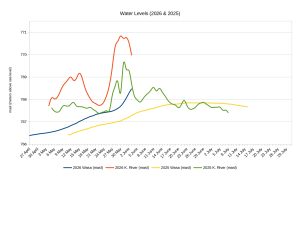
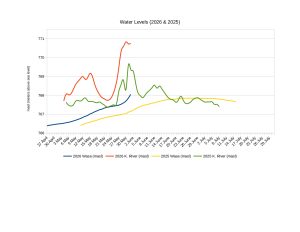
As of June 8, 2026, the water level at Wasa was 769.07 masl which is 1.555m (5 feet 1 inch) higher than on the same day last year.

Over the past 7 days the water has risen 1.00 meter (3 feet 3.5 in.).

Currently, the water is already 1.225 meters (4 feet) higher than the peak level last year.

Kootenay River is down another 29cm (11.5 inches). Since its peak around May 30, the river has dropped 2.85 meters (9 feet 4 inches). This will reduce the rate at which water at Wasa continues rising.

If the river does not rise again, then the level at Wasa is nearing its peak.

Water level updates will be posted on the WLLID website every few days.

7 June Water Report

June 7, 2026

As of June 7, 2026, the water level at Wasa was 769.01 masl which is 1.525m (5 feet) higher than on the same day last year.

Over the past 7 days the water has risen 0.95 meters (3 feet 1 in.).

Currently, the water is already 1.165 meters (3 feet 10 in.) higher than the peak level last year.

The volume of water added since freshet started is equal to 3.6 million cubic meters, or 3.6 billion liters which is approximately 1,440 Olympic-size swimming pools.

Kootenay River is down another 38cm (15 inches). Since its peak around May 30, the river has dropped 2.56 meters (8 feet 5 inches). This will reduce the rate at which water at Wasa continues rising.

If the river does not rise again, then the level at Wasa is nearing its peak.

Water level updates will be posted on the WLLID website every few days.

June 5 Water Update

June 5, 2026

On June 5, 2026, the water level at Wasa was 768.79 masl which is 1.385m (4 feet 6.5 inches) higher than on the same day last year.

Over the past 7 days the water has risen 1.1 meters or three feet seven inches.

Currently, the water is already 94.5cm (3 feet 1 inch) higher than the peak level last year.

The average peak water level since 2014 is 768.63 masl.

The volume of water added since freshet started is estimated to be 3.26 million cubic meters, or 3.26 billion liters which is the same as 1,300 Olympic-size swimming pools.

Water updates will be posted on the WLLID website every few days as we approach peak water.

June 3 Water Update

June 3, 2026

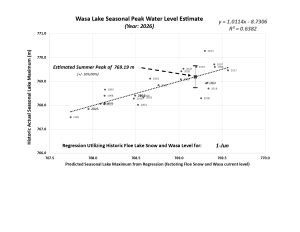
The WLLID monitors water levels and tracks data going back to the early 1990s. Using that data and historical snow pack levels at Floe Lake, statistical analysis shows that a significant portion of the water level increase comes from the Flow Lake snow pack.

Based on analysis of this years data-Wasa water level and Floe Lake snow pack-WLLID estimates the peak water level this year will be 769.20 masl, plus or minus 10%. This means the peak water will fall between 768.74 on the low side and 769.65 on the high side.

For lake front residents who have experienced flooding in the past, WLLID suggests taking some early precautions to protect buildings and property.

There have only been three previous years when the water level peaked above 769.00. They were 2022, 2020 and 2017.

The average peak water level since 2014 is 768.63 masl.

As of June 3, 2026, the water level at Wasa was 768.48 masl which is 1.20m (3 feet 11 inches) higher than on the same day last year.

Over the past 7 days the water has risen 1.0 meters or three feet three inches.

Currently, the water is already 64cm (2 feet 1 inch) higher than the peak level last year.

The volume of water added since freshet started is equal to 2.78 million cubic meters, or 2.78 billion liters which is the same as 1,111 Olympic-size swimming pools.

Water updates will be posted on the WLLID website every few days as we approach peak water.

June 1 Peak Water Estimate

June 1, 2026

If it seems like there is more water, that’s because there is.

As of June 1, 2026, the water level at Wasa was 768.05 masl which is 0.90m (2 feet 11 inches) higher than on the same day last year.

The last two days saw water rise 30cm or one foot.

Currently, the Wasa water is already 20cm (8 inches) higher than the peak level last year.

The volume of water added since freshet started is equal to 2.15 million cubic meters, or 2.15 billion liters which is the same as 860 Olympic-size swimming pools.

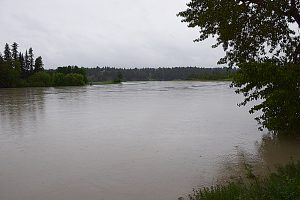
The Kootenay River is running high sitting at 770.76 masl. The photograph below was taken June 1, 2026.

The WLLID monitors water levels and tracks data going back to the early 1990s. Using that data and historical snow pack levels at Floe Lake, statistical analysis shows that a significant portion of the water level increase comes from the Flow Lake snow pack.

Based on analysis of this years data-Wasa water level and Floe Lake snow pack-WLLID estimates the peak water level this year will be 769.20 masl, plus or minus 10%. This means the peak water will fall between 768.74 on the low side and 769.65 on the high side.

There have only been three previous years when the water level peaked above 769.00. They were 2022, 2020 and 2017.

The average peak water level since 2014 is 768.63 masl.

For lake front residents who have experienced flooding in the past, WLLID suggests taking some early precautions to protect buildings and property.

Water updates will be posted on the WLLID website every few days as we approach peak water.

20 May Water Update (2026)

May 21, 2026

Water Level Update

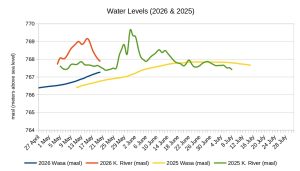
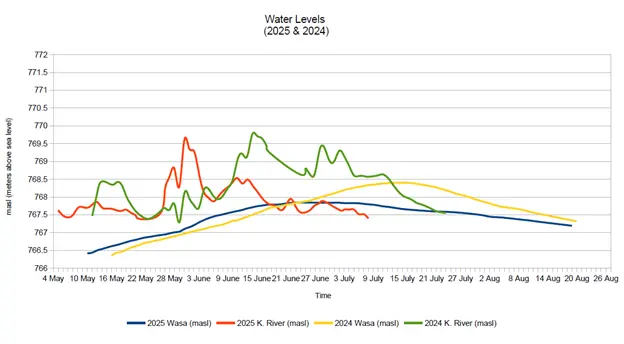
While the water here at Wasa began rising a few days before, on April 27th the level reached the WLLID’s lake gauge. This was 15 days earlier than last year when water reached the gauge on May 11th, 2025.

As of 20 May, the water level at Wasa was 767.27 masl (meters above sea level), which was not reached last year until June 3.

Today’s water level is 0.50 meters (1 foot 8 inches) higher than the same date in 2025.

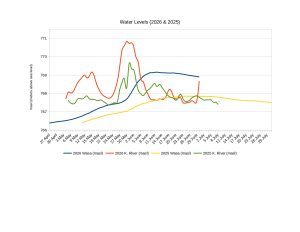
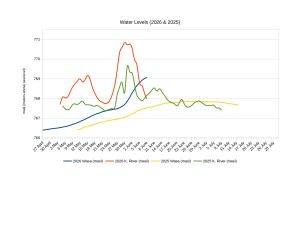
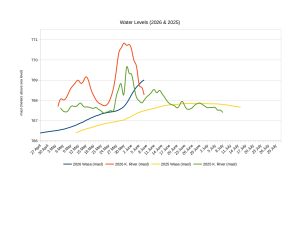
The graph below shows a comparison of current and last years lake and river levels.

Water level updates will be posted on www.wasalake.ca weekly, daily in June until peak.

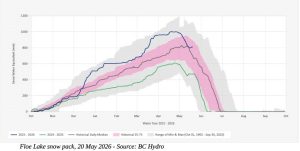
Also on 20 May, the Floe Lake snow pack was 32.19 inches (snow water equivalent) which is 115% of normal.

The snow pack level at Floe Lake has a significant impact on the Wasa peak water level.

WLLID expects the peak water level to be higher than last year.

On June 1, we will publish an estimate of the peak water level. It will be posted on the website, www.wasalake.ca.

Water Season Ends, AGM Next

October 9, 2025

With the Wasa water season mostly over, the WLLID slows its activity around the lake.

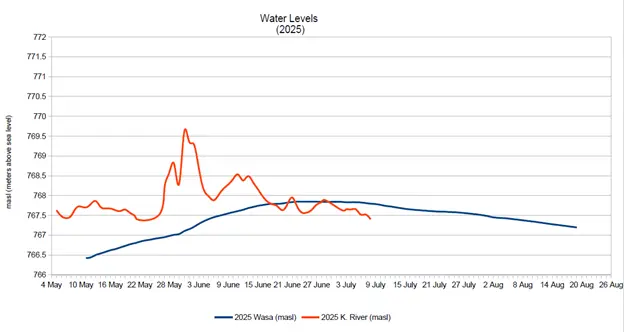
This summer was highlighted by the lowest peak water level, reached on 23 June, at 767.84 masl (meters above sea level), since 2014. this year was the second lowest in the last 25 years. Only 2001 saw a lower peak level, when the water only reached 767.50 masl.

To give you an idea of how low the water was, on 26 July, 2025, the level was 767.55 masl, 53cm lower than on the same day last year.

Last year, the peak water level was 768.40 masl. That’s 56 cm or just over 22 inches more water compared to this year.

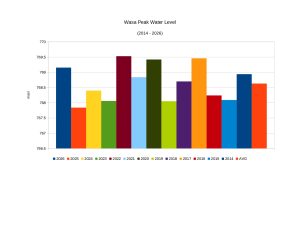
The chart below shows peak water levels since 2014.

Water testing has finished for the season. Dissolved oxygen, temperature and Seechi readings, along with E. coli sampling, will resume in early June 2026. We hope to undertake one or two winter (ice-on) tests depending on volunteer availability, ice and weather conditions.

A detailed review of the E. coli events this past summer was published in last months Buzz. It will be re-addressed at the up-coming AGM.

WLLID has a new website, same address – wasalake.ca.

The Board thanks Shawn at Eggplant Studios for his work on creating the new look and navigation. This makes it easier for the Board to post current news, water data and testing alerts. It will be the public source for verified WLLID Board information.

Past material such as Board agendas, minutes, financial statements and historical reports are still available.

The WLLID AGM is set for 15 October, 2025, 7pm, at the Wasa Community Hall. The Board will present a number of reports outlining the past years activities along with the 2024 financial statements.

Just a few days later, on 18 October, WLLID will lead the return of the shoreline cleanup.

A great day of community activity. Fun for youth and adults alike, roaming the public beaches and bagging garbage.

It all starts at 2pm, meet at the Main Beach parking lot.

Use this link to register https://app.ocean.org/app/cleanup/explore. Search for Wasa Lake under the Join Cleanup tab. Please share this link with other interested parties.

Or, just show up on the day.

A WLLID tote bag will be given to the person with the weirdest item found.

Sur-prizes inside.

Check WLLID website for up-to-date information closer to the date.

August 21, 2025

August 21, 2025

Peak Water Come and Gone

Wasa lake remains low compared to 2024. It reached a peak of 767.84 masl on 23 June and remained there until the 2nd of July.

Only 2001 saw a water level lower than this year when it peaked at 767.50 masl.

As of 15 July, the water level was 767.665 masl, 73.5cm lower than on the same day last year. Recent rains will help keep the lake from falling faster than normal.

While the Kootenay River remains steady, it is also at a much lower level than past years.

​WLLID will hold “Water Day” on 26th July, 12 noon to 3pm, at Campers Beach. Come out with the family and enjoy a free BBQ along with water testing demonstrations by WLLID and Living Lakes Canada. Invasive species information and children’s activities will be provided by EK Invasive Species Council.

​Families will learn how to keep Wasa water healthy for future generations, including aquatic life. Learn more about RDEK’s flood response and sign up for alerts and evacuation notices here.

Wasa Lake Land Development District Logo